A working wartime aerodrome — hangars, runways and all — turned into Scotland’s finest collection of flying machines, anchored by the Concorde that came home to land.
§ IGrass, Concrete and Memory
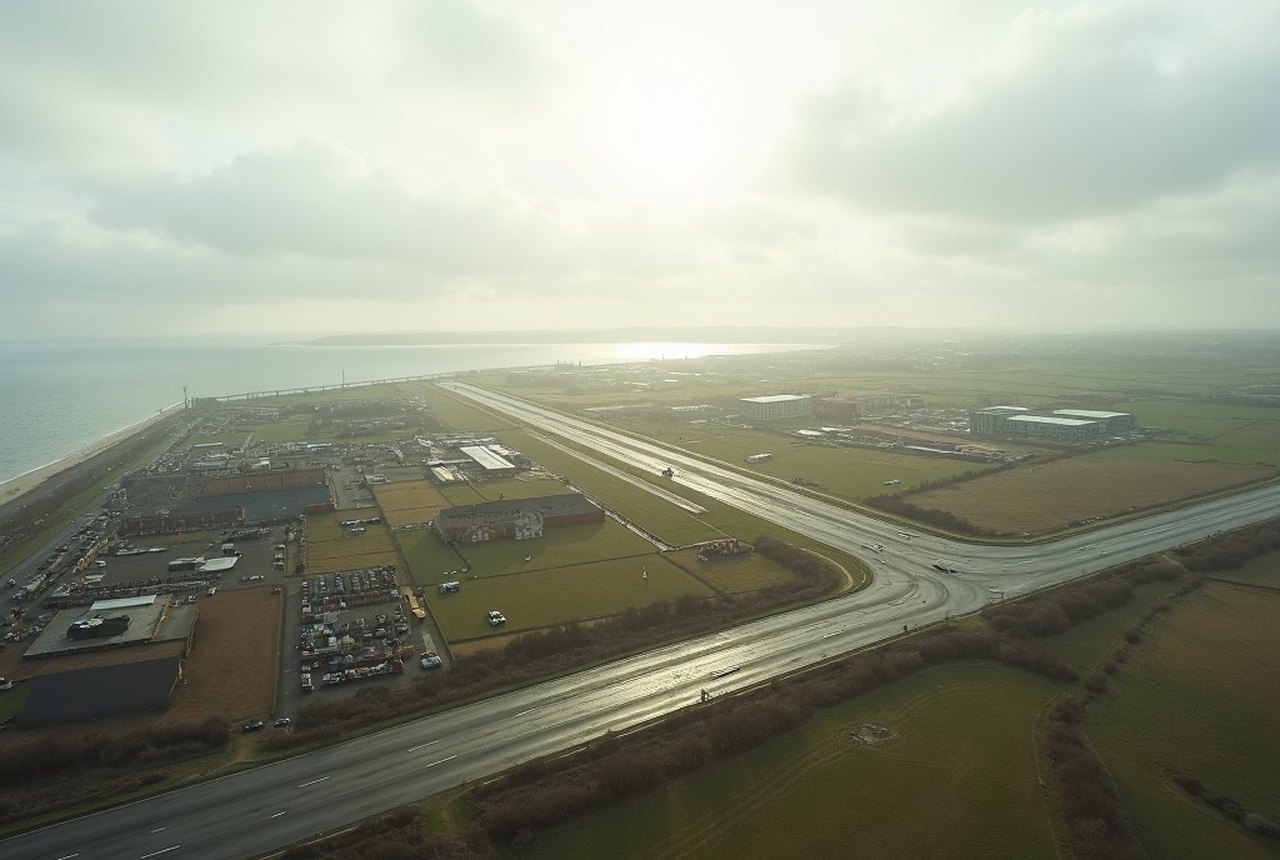
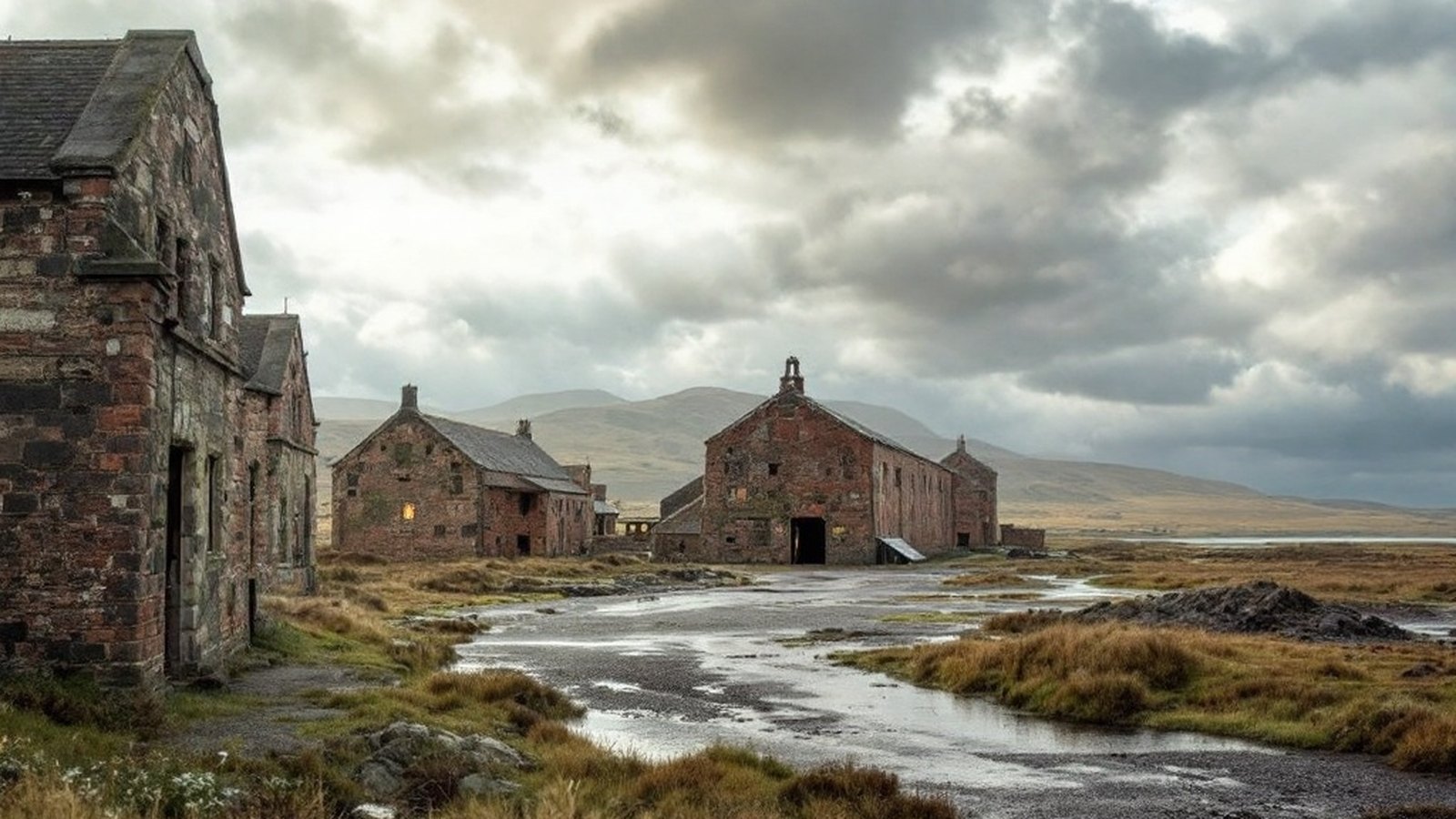
There is something quietly remarkable about arriving at East Fortune. Most aviation museums occupy a purpose-built shed on the edge of a trading estate, their aircraft arranged like furniture in a showroom. East Fortune is different. The site is a real aerodrome — flat, wide, exposed to the Lothian sky — and the collection inhabits the buildings the aerodrome itself left behind: long, low wartime hangars, brick-and-timber structures that smell faintly of oil and cold metal, their corrugated rooflines unchanged since the 1940s. To walk in here is to understand, physically, what a military airfield felt like. The aircraft are not displayed so much as sheltered.
The field lies in the coastal plain of East Lothian, a few miles from the small town of East Linton and a short distance inland from the Firth of Forth. It occupies one of those flat, drained stretches of former moss that the county’s agricultural improvers opened up in the eighteenth century, ideal ground for what would become one of the most significant airfields in Scottish aviation history. The landscape is still agricultural on three sides, and on a clear day the Lammermuir Hills rise to the south. It is a place that wears its history lightly — until you start looking.
East Fortune’s aviation story begins in the First World War. The Royal Naval Air Service established a station here in 1915, and the site was developed as a base for airships — those vast, slow, hydrogen-filled envelopes that the Admiralty pressed into service for coastal patrol work, watching for German submarines in the Forth and the North Sea beyond. The hangars required to house such craft were enormous, and the footprint of what was built here has largely dictated the character of the museum ever since. Aircraft of the period rarely left traces this durable. East Fortune did.
The airfield passed between naval and military control during the war years, expanding to accommodate conventional aircraft alongside its lighter-than-air work. By the armistice it was a substantial and well-equipped station. What followed, in July 1919, would make it famous.
§ IIThe Airship That Crossed an Ocean
On 2 July 1919, His Majesty’s Airship R34 lifted from East Fortune and set a course westward across the Atlantic. It was the first ever east-to-west crossing of that ocean by an aircraft of any kind — a crossing made against the prevailing winds, which made it technically the harder direction by far. The R34 reached Mineola, Long Island, after a journey of just over 108 hours, touching down on 6 July. The return crossing was completed in approximately 75 hours, wind-assisted and rather more comfortable.
The R34 was a British-built rigid airship — a development of the German Zeppelin type, constructed at William Beardmore and Company’s works at Inchinnan in Renfrewshire. It measured some 643 feet in length and was powered by five Sunbeam Maori engines. The crew numbered 30, with a small number of passengers, and included one stowaway who had concealed himself in the tail before departure and whom the captain, Major George Herbert Scott, chose to retain aboard rather than turn back. The airship also carried, in a gesture characteristic of the era, a small mail consignment — symbolic cargo for a momentous journey.
What the R34’s crossing demonstrated was that regular transatlantic air travel was technically possible, even if hydrogen-filled giants were not the long-term answer. Alcock and Brown had flown the Atlantic in a fixed-wing aircraft weeks before, on 14–15 June 1919, but their Vickers Vimy had crossed west-to-east in a single, continuous, uncontrolled dash. The R34 carried a crew, operated at a sustained pace, and returned under its own power. The distinction matters. East Fortune was, for that brief summer, the departure point of something genuinely new in the history of travel.
The airship itself is gone — lost in a crash over Yorkshire in 1921 — but East Fortune commemorates the R34 with conviction. Panels, models and archival material tell the story in the hangar interiors, and the grass alongside which that vast hull was walked out before dawn remains, roughly, beneath your feet. Few museums can claim a monument as substantial as the ground itself.
On 2 July 1919, His Majesty’s Airship R34 lifted from East Fortune and set a course westward across the Atlantic
§ IIIThe Collection and the Hangars
The National Museum of Flight is part of National Museums Scotland, and its collection spans military, civil and experimental aviation from the earliest flying machines to the supersonic age. The exhibits are housed across several of the original hangars, each building given over to a different era or theme, so that a visit moves through time as it moves across the site.
Among the military aircraft, the collection holds examples that range from a de Havilland Tiger Moth to a Hawker Hunter, from a Spitfire to a Lightning, the last of those great single-seat British interceptors, its pencil fuselage and stacked engines a reminder of how extreme the demands of Cold War speed had become. The civil aviation hangar traces the story of commercial flight, with airliners that once flew scheduled routes now standing in the curious dignity of retirement. There is also a dedicated exhibition space given over to the social history of flight — what it meant to passengers, ground crews and the communities beneath the flightpaths.
The hangars themselves deserve attention as industrial structures. Several date from the First World War period, their timber-framed construction and corrugated-iron cladding typical of rapid wartime building. Others are products of the Second World War expansion, when East Fortune was reactivated as a Royal Navy Fleet Air Arm station known as HMS Fieldfare. The mixture of periods is visible in the architecture, if you care to look — different rooflines, different materials, different structural logic — and the whole constitutes a largely intact example of a wartime aerodrome complex, a type that has been demolished or built over almost everywhere else in Scotland. East Fortune’s flat ground and relative isolation from development pressure have, providentially, preserved it.
The concrete runways laid in the 1940s remain in place. Visitors walk or drive on surfaces that once bore Swordfish and Barracuda aircraft off to exercises over the Forth. There is a particular quality of pathos — or perhaps simply of history — about standing on a stretch of wartime runway on a grey East Lothian morning, looking out at nothing, and understanding that this emptiness is precisely the point.
In brief — a chronology
- 1915RNAS establishes airship station at East Fortune
- 2 July 1919R34 departs East Fortune on first east–west Atlantic crossing
- 6 July 1919R34 arrives Mineola, Long Island, after 108+ hours
- 1921R34 lost in crash over Yorkshire
- WWIIEast Fortune reactivated as HMS Fieldfare (Fleet Air Arm)
- October 2003British Airways retires Concorde fleet
- 4 April 2004Concorde G-BOAA flown in to East Fortune
§ IVConcorde Comes Home
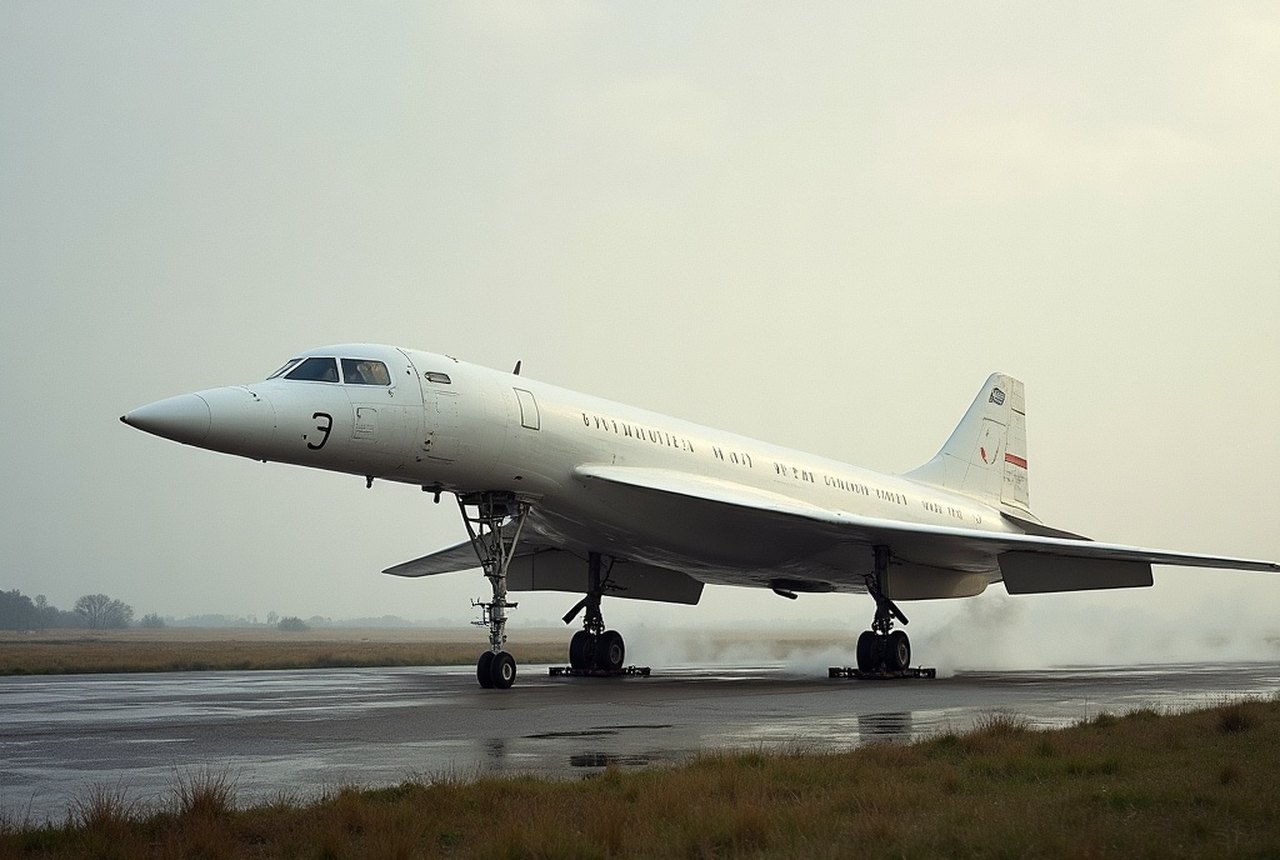
The most celebrated resident of East Fortune arrived on 4 April 2004. Concorde G-BOAA flew in under its own power, landing on the airfield’s runway in an event that drew large crowds and considerable national attention. It was one of the last flights made by any Concorde: British Airways had retired the type the previous October, ending twenty-seven years of supersonic passenger service. G-BOAA is the oldest surviving British Airways Concorde, the first of the airline’s fleet to enter service, doing so in January 1976 on the London–Bahrain route. It accumulated well over 22,000 hours of flying time in its career.
Concorde’s arrival at East Fortune was not simply a matter of finding a parking place for a famous aircraft. The decision to bring G-BOAA here, rather than to a more southerly institution, was a recognition that Scotland had played a real role in the Concorde story — not least through the extensive contribution of Scottish engineering firms to the aircraft’s production, and through the fact that Prestwick Airport had been used as a testing and delivery base during the programme. Scotland, in short, had earned its Concorde.
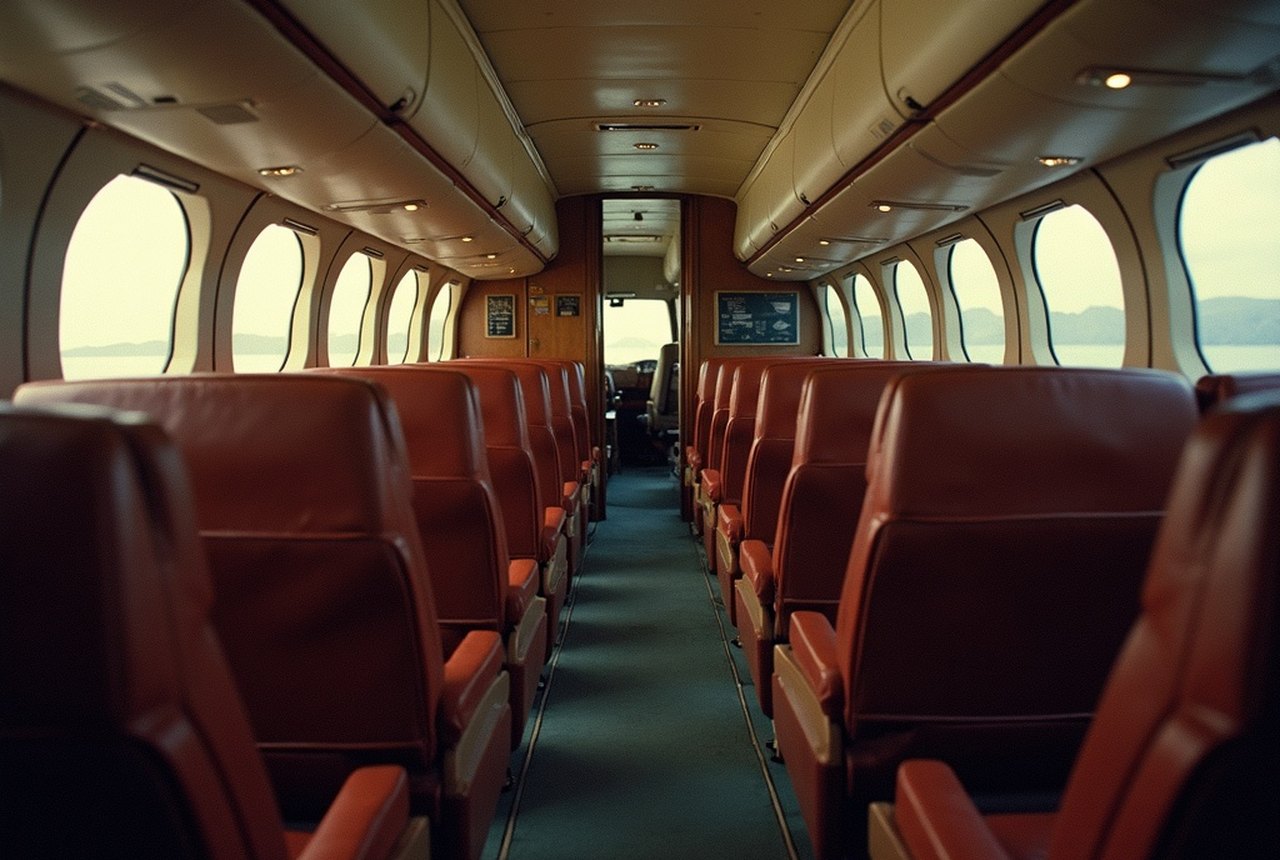
The aircraft is displayed in its own purpose-built hangar, and the experience of encountering it up close is one of the best things this museum offers. Concorde is always surprising in the flesh: slender to the point of improbability, the fuselage barely wider than a large saloon car’s length, the delta wing immense by comparison, the drooping nose giving the aircraft a watchful, slightly predatory expression at rest. Visitors can board and walk through the cabin — 100 seats in a tube that would feel intimate on a regional commuter jet — and in doing so grasp what supersonic transatlantic travel actually involved: not comfort, exactly, but compression, the trading of space for time, the peculiar privilege of arriving before you seemed to have left.
G-BOAA flew at Mach 2, twice the speed of sound, at altitudes above 55,000 feet. At that height the curvature of the earth is visible, and the sky above shades from blue into the beginning of black. It is a long way, in every sense, from the cold corrugated hangars and the airship sheds of 1915. That both stories can be told on the same piece of Lothian ground is what makes East Fortune, among Scottish museums, genuinely irreplaceable.